Back in the early 90s, I found myself standing on the edge of a sulfurous wonderland: Unzen, Japan. With my trusty Bronica SQ-Ai slung around my neck, I wandered through an otherworldly landscape of hot springs, steam vents, and meticulously sculpted gardens. Decades later, those moments remain etched in my mind—and in the square negatives I captured on that crisp day.
Unzen, tucked away in Nagasaki Prefecture, is a place where the earth itself breathes. Steam rose from the ground in twisting white columns, filling the air with a faint tang of sulfur. Known for its “hells” (Unzen Jigoku), the area was both beautiful and intimidating. In the early morning light, the mist from the hot springs mingled with the low clouds, shrouding everything in a soft, ethereal glow.
I had been traveling around Kyushu with the Bronica SQ-Ai, a beast of a camera that demands you to slow down and really consider each frame. It wasn’t my first medium-format camera, but it was undoubtedly the most rewarding. With its modular design, bright waist-level viewfinder, and robust leaf-shutter lenses, the SQ-Ai offered a level of control and image quality that was unparalleled.
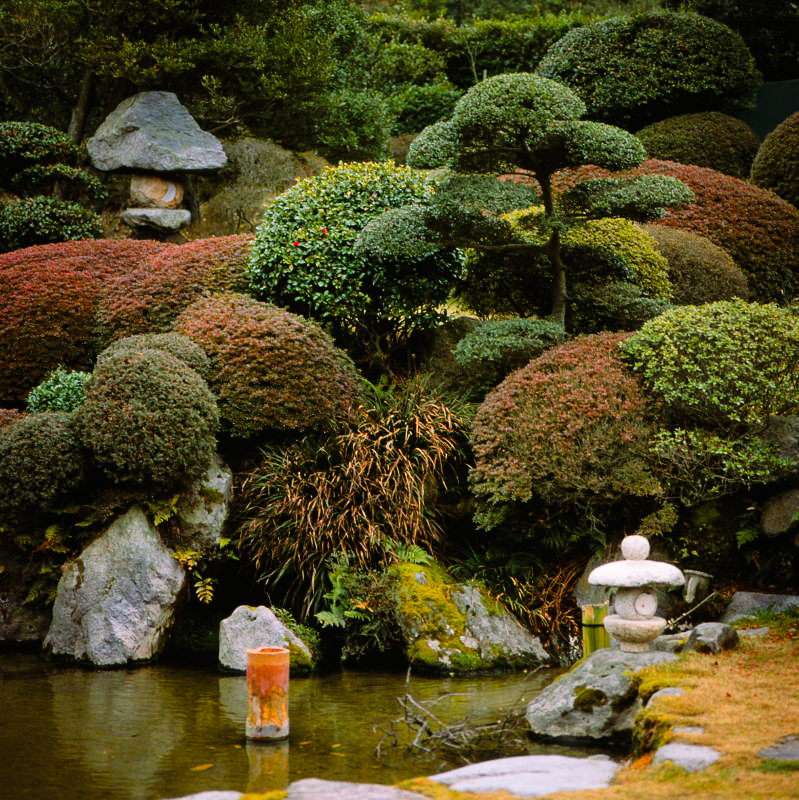
That morning in Unzen, I wandered through the gardens, where nature had been tamed and yet allowed to show its wild heart. The meticulously pruned shrubs and trees curved in elegant arcs, while the mossy stones and bubbling ponds reflected the quiet drama of the hot spring steam. Every turn of the path revealed another vignette of natural art, a dance of shapes and colors that felt both ancient and immediate.
The SQ-Ai, loaded with a roll of Fujifilm Velvia, was my partner in crime. The 80mm Zenzanon-PS lens—sharp as a tack and with just the right field of view for these intimate landscapes—let me capture the essence of the gardens without crowding the frame. Velvia’s rich, vibrant palette was perfect for the riot of greens and deep reds in Unzen’s gardens, rendering every leaf and stone with startling clarity. Looking down through the waist-level finder, I felt almost as if I were peeking into another world, one that existed only for me and my camera.
Amid the beauty, there was a profound sense of solitude. As an outsider in Japan, I felt both a profound sense of wonder and a quiet sense of alienation. The language, the customs, the layers of history—all of it was new and unfamiliar. Yet in the gardens of Unzen, that solitude felt welcome, even necessary. There were no crowds, no chatter—just the murmur of water, the sigh of steam, and the measured click of the Bronica’s shutter.
Photography, in that moment, became my bridge to a sense of belonging. The deliberate ritual of composing each frame through the SQ-Ai’s square viewfinder, the tactile precision of focusing, the weight of the camera in my hands—it was a kind of comfort. It made me feel at home, even in this foreign land. It gave me a purpose that transcended language, a way to connect to the place and its quiet soul.
One particular scene stood out: a simple pond, ringed by moss-covered stones and guarded by a weathered stone lantern. The water was still, save for the faint ripples from an underground vent that sent up little puffs of steam. The garden around it was a symphony of textures—rounded bushes tinged with autumn’s red, a solitary pine shaped like a bonsai, and the dark, rich greens of the ferns and grasses. It was quiet there, save for the occasional hiss of the geothermal vents.
With the SQ-Ai, composing the scene was almost meditative. I carefully adjusted the focus, turning the split-image circle in the viewfinder until the scene snapped into perfect clarity. The camera’s shutter, though louder than a whisper, was surprisingly gentle—just a satisfying clunk that told me I’d captured another moment. No digital preview, no instant gratification—just the tactile joy of film and the anticipation of seeing the slides weeks later.
Later, I explored the Unzen Jigoku itself—an area as dramatic as it sounds, with billowing steam and the faint echo of history. Centuries ago, it had been a place of persecution, where Christian martyrs met their fate. Now, it was a place of reflection, and as I stood there with the Bronica, I couldn’t help but feel the weight of time and the resilience of nature.
I ended the day back in the gardens, the light softening to a gentle gold as the sun dipped low. My last frames of the day were of the twisted pines and the carefully tended azaleas, their colors beginning to fade in the twilight. Each shot felt like a prayer—an offering to the stillness and beauty of this place.
When I finally developed those rolls back home, Velvia’s saturated tones didn’t disappoint. The Bronica’s square format gave each frame a sense of balance and harmony, ideally suited to the quiet strength of the Japanese garden. The detail was astounding—every moss-covered stone, every serrated leaf, every curl of steam rendered in exquisite clarity. But more than that, the images captured the feeling of that day: the peace, the history, the beauty—and, yes, the solitude that felt so right.
Decades later, those images still speak to me. They remind me that photography, at its best, is about presence. It’s about standing still in a place that matters, seeing it clearly, and letting the camera—whether digital or film—be the bridge between what you see and what you remember.
Unzen taught me that. The Bronica SQ-Ai, with Velvia’s vivid colors and square perfection, helped me bring that lesson home.
 316 Expressions