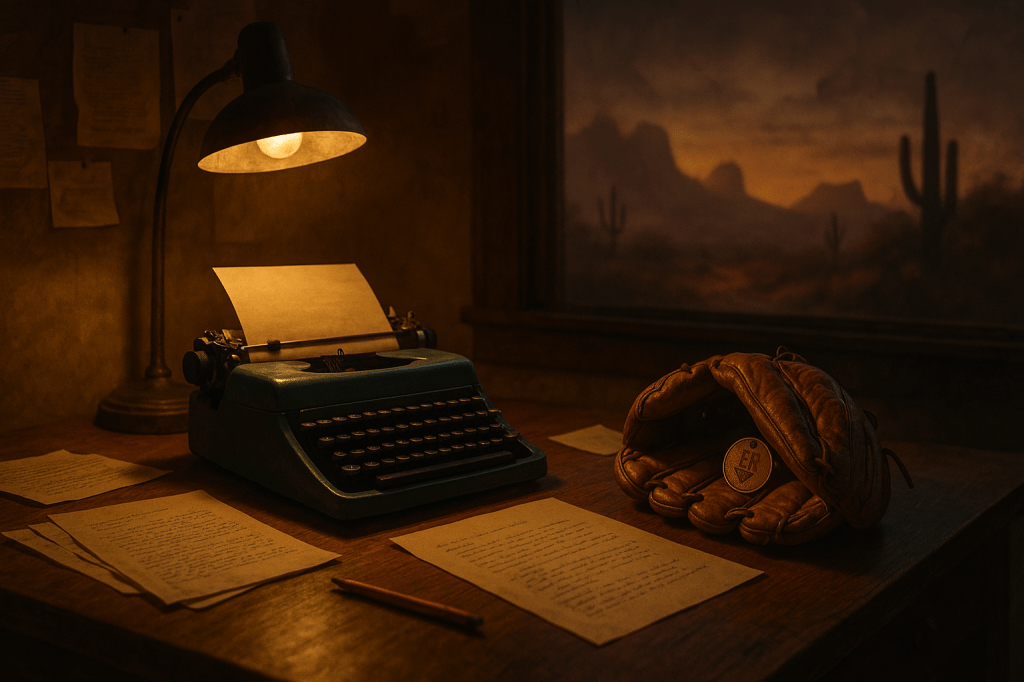
There’s a kind of freedom in being a pantser. You sit down, fingers on the keyboard, and let the characters lead. That’s how I wrote the first two books in The Lollipop Gang series—fast and loose, chasing threads of inspiration like fireflies on a desert night.
And it worked. Until it didn’t.
I tripped over plot holes big enough to swallow the El Halcón Mine when I reread those early drafts. Clues that didn’t connect. Timelines that didn’t sync. Character arcs that shifted mid-stride without warning. The mystery—meant to drive the story—kept morphing into something I didn’t recognize.
So, I did something I never thought I’d do.
I became a plotter.
Building the Bones of a Series
Mystery doesn’t leave much room for improvisation. Readers of the genre expect clever setups, planted clues, red herrings, and a satisfying payoff. And to make that work over ten books, I needed more than inspiration—I needed structure.
I stepped back from the manuscript and began building a story bible—not just a few notes but a living, breathing document. I mapped character arcs, constructed timelines, outlined key discoveries, and sketched the world around them—rooted in my childhood memories of Arizona.
Each book now fits into a four-part framework that stretches from Spring 1975 to Late Summer 1978. I aligned fictional events with historical ones. I dug into the culture of small-town Florence in the mid-70s. I researched old Circle K layouts, CB radios, school mascots, and the slang we used before the internet flattened everything out.
It wasn’t just about facts. It was about feel.
The Tag in the Glove
What truly shifted how I wrote was when I revisited the story’s spark.
Sam discovers a miner’s tag—initials “E.H.” and a hawk symbol—tucked inside her father’s old baseball glove. That glove once belonged to Jerome Thompson, who the town says died in a mining accident.
Sam doesn’t believe it. And neither do we.
That clue launches her into a decades-old mystery: What was Jerome investigating? What is the secret of El Halcón Mine buried beneath Florence’s dust? The more she digs, the more she realizes—some truths were never meant to surface.
For me, that tag meant I couldn’t wing it anymore. I had to know the past. The history. The cover-up. Every beat had to align—emotionally, thematically, and structurally.
Writing Back in Time
Setting the series in the 1970s brings unique challenges: no internet, no smartphones, and no shortcuts.
If Sam and the gang want to follow a lead, they ride bikes, dig through newspaper archives, and piece together stories from oral histories and half-buried ledgers. Every step requires effort, and that effort must be reflected in how I plotted.
The dialogue had to feel era-appropriate. Plotlines had to account for limitations in communication. Cultural references had to ring true. Even how a kid would disappear—or not—had to match the time.
I couldn’t just write what felt right. I had to build it right.
Tropes, Truth, and Tension
With a mystery series, tropes are both tools and traps. Secret tunnels. Hidden journals. Forgotten mines. A town that knows more than it says.
I embraced them but didn’t want them to feel recycled, so I grounded them in personal memory and Arizona lore. Every character, myth, and clue is tied to something real—something lived.
Sam isn’t just chasing a mystery. She’s searching for a piece of her father. Her story is a blend of defiance and grief, justice and belonging. And every character in The Lollipop Gang brings their longing to the table.
From Freedom to Framework
Becoming a plotter didn’t kill my creativity—it focused it.
The gloves-off pantser in me still shows up now and then, offering surprises along the way. But now those surprises have a home, a purpose, a place to land. Plotting allowed me to elevate the story rather than wrestle it back into coherence.
That said, don’t mistake plotting for the easier path. My current story bible is pushing 250 pages. My research notes top 400. That’s two books’ worth of scaffolding—to write the actual books.
Writing this series taught me that structure isn’t the enemy of art. It’s the work that holds the art together.
So here I am: plotter by necessity, storyteller by instinct.
And the mystery?
It’s finally making sense.
Happy writing—and potting!
Jerry Byers
Feel free to share your thoughts, experiences, or favorite writing tips in the comments below. And let us know if you are a pantser or plotter.
 316 Expressions