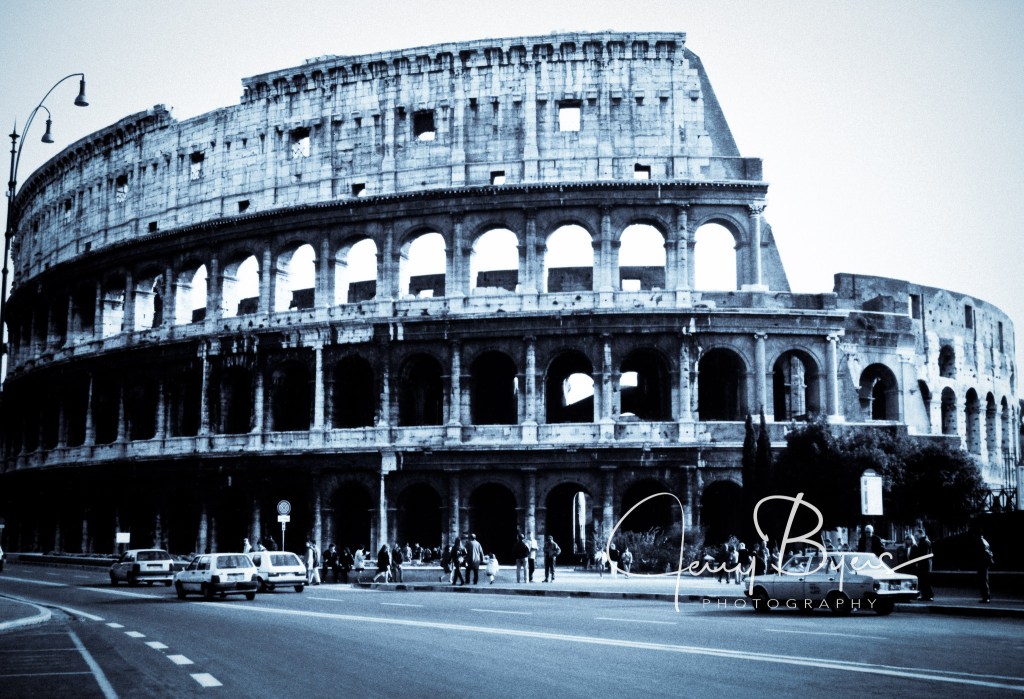
This photo was taken with a Canon EOS 10S using Fuji Velvia 50 positive film, which beautifully captures the vibrant colors of the scenes in front of me. I had an incredible opportunity to live in Italy, a country steeped in rich history and culture, and Rome quickly became one of my favorite destinations due to its incredible blend of ancient ruins and modern life. The Colosseum stood as a magnificent reminder of the architectural prowess of the Romans, embodying both the grandeur and the tumult of ancient gladiatorial contests. The Forums, too, were some of my favorite subjects, as they offered a glimpse into daily life during the Roman Empire. Each stone and pillar echoed tales of politicians, philosophers, and ordinary citizens, showcasing the vibrant social fabric of the time. This is a brief and colorful history of the Colosseum, illustrating not only its architectural significance but also its role in shaping the cultural identity of Rome.
When most people think of ancient Rome, the magnificent Colosseum often comes to mind. This grand oval amphitheater was central to Roman culture, serving as the venue where gladiators fought and crowds cheered. However, the Colosseum is much more than just an arena. It took two emperors approximately eight years to design and construct it. Vespasian initiated the project but passed away before its completion. His son and successor, Titus, finalized the construction and inaugurated the Colosseum with a celebratory 100 days of games. The structure was originally named the Flavian Amphitheater in honor of the Flavian dynasty of Vespasian and Titus.
The name “Colosseum” did not emerge until the Middle Ages, derived from a ‘colossal’ statue of Nero that once stood nearby. The amphitheater was designed to accommodate 50,000 spectators, covering about six acres and rising more than 150 feet high. After a tumultuous period in which Rome experienced four emperors within a single year, Vespasian aimed to reassure the populace and restore stability. The extravagant palace and artificial lake that Nero had built near the Forum had angered the citizens, particularly since many were suffering from starvation and disease.
Vespasian was a shrewd emperor who recognized the need to make a positive impression. He drained the lake and began construction on the Colosseum in its place, intending to provide a gift to the people: the Flavian Amphitheater. The design featured various seating classes, welcoming all groups to attend the events. The emperor and his family occupied the lowest level, followed by the upper classes, while commoners and women sat in the uppermost tiers. To protect attendees from rain or the harsh sun, poles were set up to extend fabric shelters over the audience.
It is also believed that protective nets were installed in front of the emperor to shield him from blood splatters and gore during the games. The Colosseum had 80 entrances, allowing for the quick evacuation of the audience if needed. Beneath the arena floor were holding cells for gladiators and animals. Reports exist of the Colosseum being flooded to stage mock naval battles, with water diverted from an aqueduct or channel to fill the lower cells.
When not flooded, the underground structures were used to lift animals and people up to the arena floor. Concealed elevator platforms allowed for the quick movement of enslaved individuals, gladiators, and wild animals, often without the audience noticing. Throughout its history, the Flavian Amphitheater witnessed the deaths of thousands of animals and people.
 316 Expressions